

Decluttering Checklist

If you’re interested but overwhelmed by decluttering, this is for you. This decluttering checklist is an easy-to-follow, judgement-free approach to lightening your life and home. When you start to declutter your home, your mental load lightens and your space expands!
This decluttering checklist is designed to help you make progress without burnout—one small area at a time—with clear decisions and an exit plan that actually removes clutter from your home.
I’ve been slowly working on really moving on from stuff we don’t need. Recently, however, my husband and I got into a conversation about whether or not our small house was too small. He complained about stuff not having a place and after a few days of pondering, I realized that what we needed was less stuff (which we’ve largely done), better systems and organization, and a shift in attitude.
I’ve learned in the last 5 years that clutter makes a home feel smaller and disorganized. It leaves us constantly feeling “trapped” with insufficient space. Physical Clutter = Personal Chaos.
When I shared this on Instagram, so many people reached out about how bothered they were with clutter and stuff around their homes, sharing how their home feels small – when they think it shouldn’t. And so was born this decluttering checklist AND the #TinyTidyClub – a short series of decluttering tips in 3s in a variety of places in your life.
Decluttering is often seen as a whole house or whole room purge and it can easily get overwhelming like that. You might lose focus of just one room or one project (one thing always leads to another, doesn’t it?). You might get lost in the process of what you’re trying to do and how to do it.
Mostly, I’ve found that too big a project just leads to unfinished business and not knowing how to get rid of things (responsibly) keeps things in your space even after the ‘work’ is done. So here is a checklist that includes the best way to get rid of things that isn’t just throwing it away!
Here we’ll talk about decluttering with a wonderful free printable checklist to get you started. You can also see how we reduce waste at home and how we keep a clean house!
CONTENTS
Decluttering Checklist
Having a decluttering checklist provides structure and direction. It lets you systematically progress through decluttering and come and go as you’re able.
A decluttering checklist helps you to avoid randomly moving from one area to another and it helps prevent decision fatigue. This checklist has goals, guidelines, and organization information all in one place!
What Does Decluttering Mean?
Decluttering is the process of removing items that are unnecessary, unused, or unwanted from your space. Remember that one less thing is still less clutter – it’s just like living sustainably (see what does it mean to be eco-friendly).
Decluttering allows you to improve organization, functionality, and overall quality of life. Items around you that are unnecessary, unused, or unwanted take up mental space as much as they take up physical space. By reducing the number of items that need to be stored or managed, you can reduce your mental load.
Decluttering isn’t organizing. Decluttering is about removal of items (out and away from your space). Organizing is about placement – no removal intended. You cannot organize clutter.
Because each of our lives and homes is different, decluttering will look different for each household. Further, decluttering is a constant for all of us because we accumulate things but also because our lives change. What was one necessary might now be superfluous.
Why Decluttering Is Important
Easier Cleaning and Maintenance
The math is easy on this one. Less stuff requires less clean up and organization. And when everything has a place, cleanup isn’t confusing. It’s straightforward and easy.
Reduced Stress and Mental Overwhelm
The math doesn’t math on this one, but having fewer clothes honestly makes getting dressed so much easier. It’s like I know it at all, can nail it all, and I don’t have decision fatigue.
Better Use of Available Space
All our homes have spaces that will always be the place for “stuff.” The less stuff you have (i.e. successful decluttering), the more space you have. Even those places that collect ‘stuff’ won’t be as overwhelming.
Improved Productivity
The less stuff you have to clean, the more time and mental space you have to do anything else. The less stuff you stare at in frustration, the more mental space you have for whatever. Everything just becomes easier in that space – and cleaning up becomes a much more seamless process.
More Efficient Daily Routines
Efficient morning and daily routines don’t happen naturally. There’s planning and consistency that go into it. Clutter complicates this process. Items are more easily lost.
Less Duplicate Purchasing
How many times have you bought something only to realize you already had it? We’ve all done it. Duplicate purchasing happens when you can’t locate an item easily. First and foremost, things need a place (yes, even backup products), so you can efficiently check those places to determine need. Second, you need less stuff getting in the way of you locating an item.
Easier Moving and Downsizing
If you move or decide to do a downsizing/’purge,’ it’ll be easier when you’ve successfully decluttered your home. Yes, there’s less stuff to move, but there’s also less unnecessary stuff, which is what can be a hindrance.
When you can’t simply pack and move or organize, you get lost in the abyss. Finding items and wondering if you need them, where they should go, or wondering how it got there all muddy the waters of productivity here.
The common thread here isn’t perfection—it’s ease. Decluttering creates a home that supports you instead of demanding from you.
What Causes Clutter In Your Home
Clutter is often the result of one or more of the following things
- keeping items just in case
- emotional attachment
- impulse purchases
- duplicate items
- unfinished projects
- lack of regular decluttering habits
- kids
Emotional attachment is one of the biggest causes of clutter. Emotional attachment can be guilt, love, loss, and desire.
And for those of you with kids, you’ll understand why it’s on the list. Our one son – in elementary school – brings home work and art every week. He also brings home toys and gifts. This is all on top of the things we already own.
I won’t touch much on this topic here because parenting is not a topic I cover, but I will share openly and honestly that it requires vigilance in keeping down the kid-related clutter.
And while we try to hold our son responsible for his messes and “organization” of his toys and stuffed animals – sometimes mom or dad just taking care of some things quietly when he’s out is the answer!
None of these mean you’re doing something wrong—they simply mean your life is full. Understanding why you keep items also helps provide clarity of if you need it.
How To Decide What To Declutter
I’m going to breakdown a series of places and items to declutter below, but here are the general deciding factors for how to decide what to declutter:
If it is broken or expired, remove it immediately
These are the easy decluttering checklist items – things that are broken or expired.
Fixing broken items might seem admirable, but for most of us, it’s an improbability. It’s ok to part with something.
And expiration dates are a wonderful aid in knowing if a product is working to its full potential. Pantry items (e.g. canned foods, spices, etc.)are easy to start with for this reason. I don’t run a hard-stop with an expiration date, but it gives you a good range. A few months out on a medication – probably fine. A few years? Let it go. I use this for expired sunscreen as well!
If you have not used it in the past 12 months, let it go
Items in your personal space should be there for an active reason. Holding onto something because you might need it one day isn’t a good idea. Connect with community members in a Buy Nothing Group or the like to give/get items as needed.
If you can’t remember if it’s been 12 months since you used it, assume it’s been that much time and more. While out of season items (like holiday decor) make this feel tricky, most things that fall into this category are more day to day items. And if you haven’t used them in a while, get it out of your space.
A caveat to this rule, but still relevant, is paper clutter. It’s so easy to save papers. They pile up nice and easily until the pile is terrible and unruly. Sit yourself down with a stack and separate everything into keep (meaning organize and file away somewhere), recycle, or shred.
Some items can be found online and/or others can be scanned or photographed and then move along. Paper clutter is usually how our desk drawers and home offices become chaotic.
If you own multiple versions of the same item, keep only what you use most
I would normally call this downsizing, but decluttering is definitely a form of downsizing. You don’t need multiples of a single item (exceptions include silverware ;)). Pass on a duplicate to someone else in need and get that space back.
The example in our house? We moved into our current house with at least 5 wine bottle openers. They’d been gifted, bought on vacation, etc. Initially we narrowed it down to two – the one I preferred and the one my husband preferred. Now we’re down to just one!
Other common examples of duplicate items in households: water bottles, reusable shopping bags (how many do you actually ever need at one time), can openers, black tank tops (just sayin), and probably half of your junk drawer!
If you forgot you owned it, you probably do not need it
Don’t think about items you forgot you owned as “found” or “rediscovered.” Instead, these are items you’ll be moving along.
These guidelines aren’t rigid rules—they’re decision aids. If something truly supports your life, you’re allowed to keep it.
You don’t need motivation or a free weekend to start—just a small decision and a clear next step.
Decluttering Checklist (Free Printable)
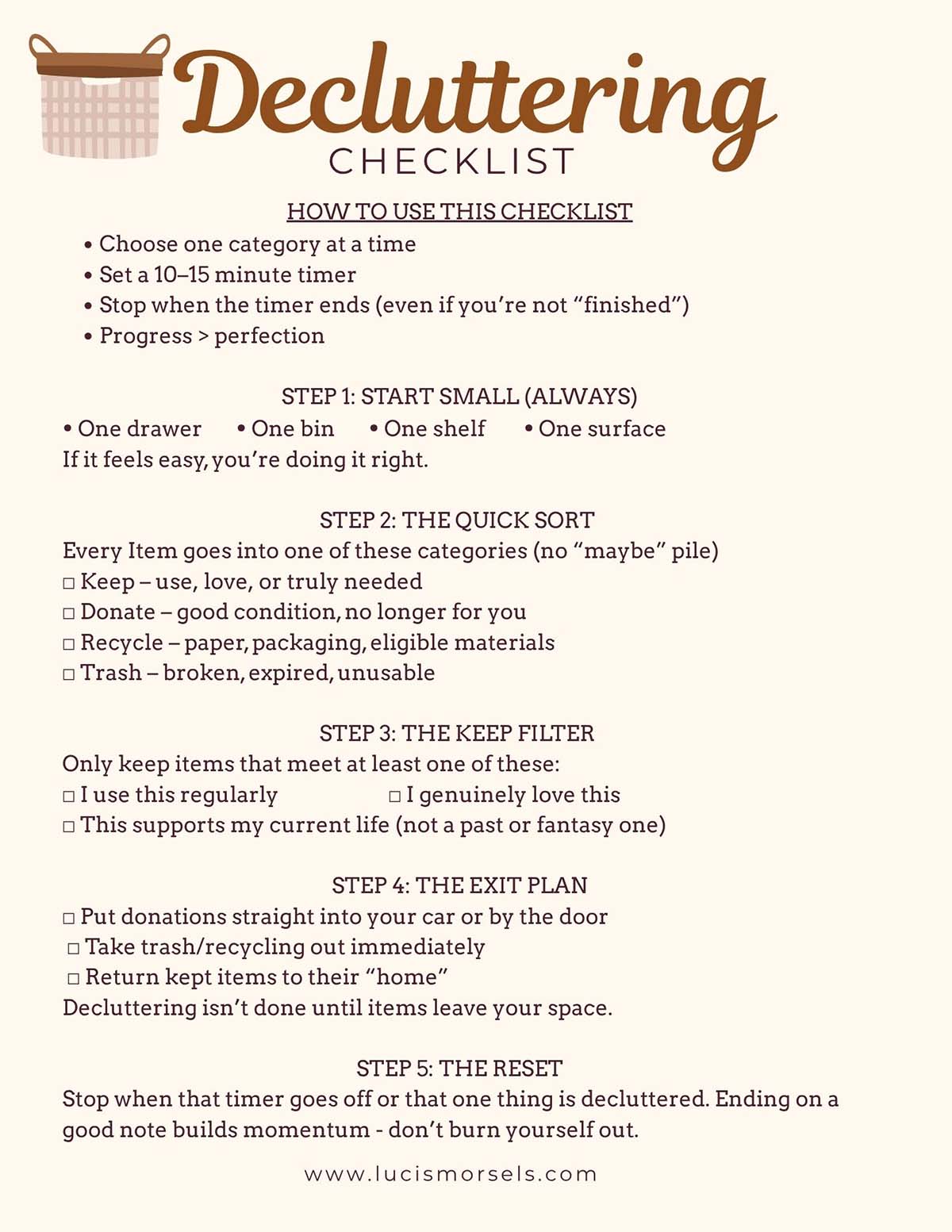
Below is my free printable decluttering checklist—created to help you start small and actually finish. Save it, print it, or come back to it whenever your space starts to feel heavy. Want this emailed to you? Click here.
Want to see how others are decluttering? Check out #TinyTidyClub on Instagram
How to Use This Decluttering Checklist
This checklist isn’t meant to be completed in one weekend. Use it as a guide you return to again and again. Choose one small area, set a 10–15 minute timer, and stop when the timer ends—even if you want to keep going. Consistency matters more than completion.
STEP 1: START SMALL (ALWAYS)
- One drawer
- One bin
- One shelf
- One surface
If it feels easy, you’re doing it right.
STEP 2: THE QUICK SORT
Every Item goes into one of these categories:
- Keep – use, love, or truly needed
- Donate – good condition, no longer for you
- Recycle – paper, packaging, eligible materials
- Trash – broken, expired, unusable
There is no “maybe” pile. Trust your first instinct. Maybe is how we avoid decluttering and end up with items we don’t need.
STEP 3: THE KEEP FILTER
Only keep items that meet at least one of these:
- I use this regularly
- I genuinely love this
- This supports my current life (not a past or fantasy one)
This last one is a key one. We often get tied up in times that aren’t the present (real or imagined). And this is when we hold onto things we don’t need. Clothes that don’t fit, sports gear, and gifts are the prime contenders for this category.
STEP 4: THE EXIT PLAN
Once I select the items I want to declutter, I often get stuck. I know there’s life left in many of these items and/or I feel bad just throwing them in the trash where they’ll go to the landfill.
Successful decluttering isn’t really complete until things have been removed from your home/space.
- TRASH/RECYCLING – Take trash/recycling items out immediately. This is the quick win.
- GIVING AWAY – Put donations straight into your car or by the door to drop off. List things soon on Buy Nothing Groups or for free on Facebook Marketplace. Please be mindful of only dropping off items in good condition to secondhand stores. Would you buy the thing as is? If not, then don’t donate it. For clothing, get yourself a trashie bag (learn more about how to recycle clothes).
- SELLING – I’m not a fan of selling items after a decluttering or closet purge. I love the idea, but often there’s a waiting period before they’re listed and then sold – this prolongs the clean out period. If you can take items to a quick buy-sell shop, that’s a good idea. And then just giveaway/donate the rest.
Responsible decluttering isn’t about perfection—it’s about making thoughtful choices and then letting items move on.
STEP 5: THE RESET
Since you started small and with a manageable task – a timer of 10-15 minutes or a single bin/drawer/etc., let that be your hard stop for now. You aren’t going to declutter your whole space in one afternoon, so end on a high note.
STEP 6: MAINTENANCE (How to Prevent Re-Cluttering)
Before bringing anything new into your home, pause and ask yourself, “where will this live?” If there isn’t a clear answer, maybe you don’t need it now OR something else may need to leave first. This prevents re-cluttering (undoing your hard work).
This step is what makes decluttering sustainable—especially in small spaces and real life.
Decluttering Checklist by Area
This second free printable PDF is your action sheet – a decluttering checklist by area in your home. Remember each room doesn’t have to be completely decluttered all at once.
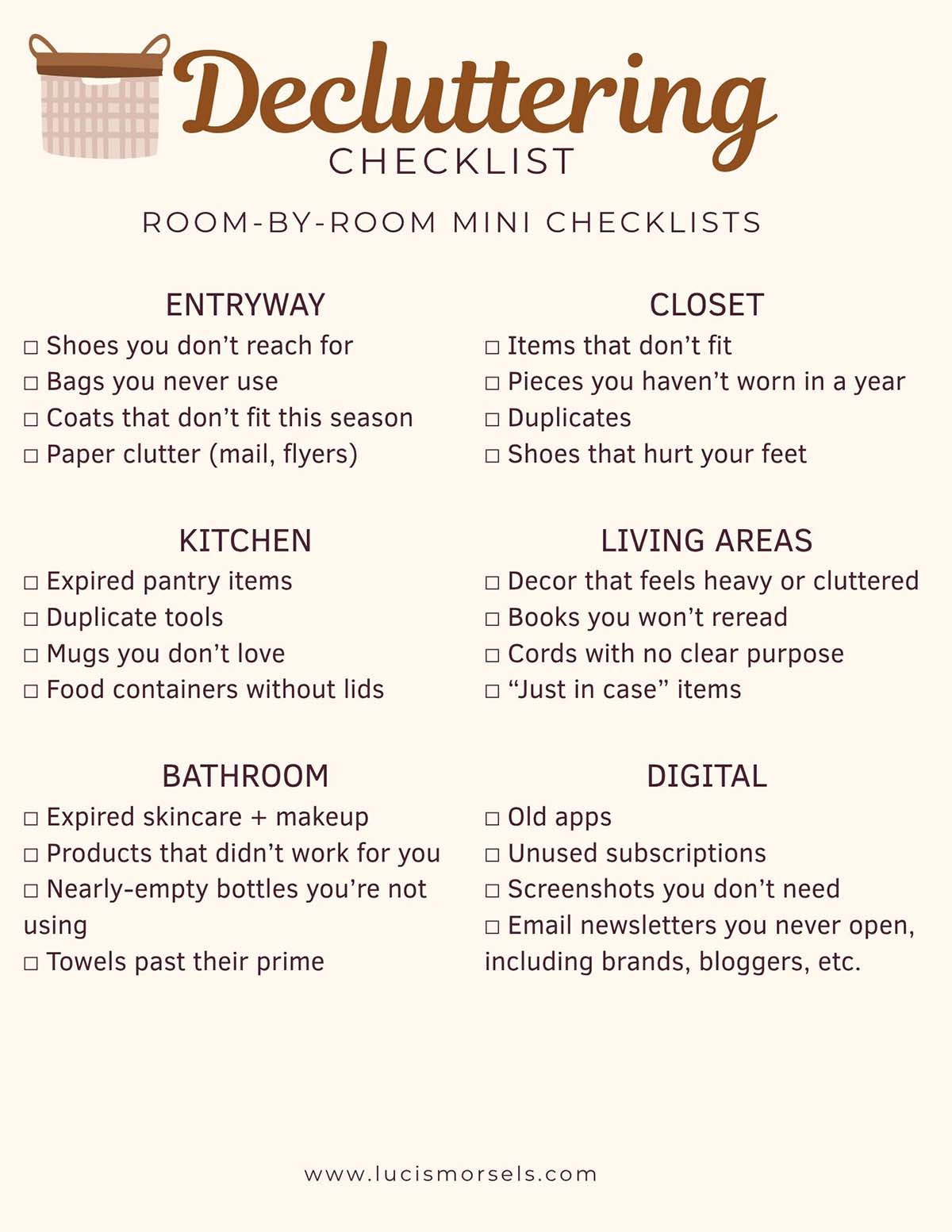
Use this checklist as a guide, not a rulebook. Progress counts—even one drawer at a time.
And if your space starts to feel heavy again, you’ll know exactly where to begin.



I love this. Is there a link to click, to get to the pdf? I can’t find it.
Hi Theresa! So glad you find this helpful. Here is the link. It’s a signup page and the list will be emailed directly to you!